




Sitting at your desk for hours and then realising that nothing stuck isn't a problem of time; it's a problem of method. A handful of techniques let you learn much more in the same amount of time, and you can start using all of them today.
Short answer: Work in focused 25 to 50 minute blocks (the Pomodoro method), test yourself instead of rereading your notes, revisit topics on different days, and keep distractions out of reach while you study.
1. The Pomodoro method: study in focused blocks
The Pomodoro method is a simple time management technique developed by Francesco Cirillo in the late 1980s:
- Pick one task and set a timer for 25 minutes.
- Work only on that task until the timer rings.
- Take a 5-minute break.
- After four Pomodoros, take a longer 15 to 30 minute break.
Its strength is that it turns a big, intimidating task into blocks that are easy to start, "just 25 minutes". Getting started is the hardest part, and a short block lowers that barrier. If 25 minutes feels too short, try 45 or 50 minute blocks. What matters is that you don't split your attention during the block and that your breaks are real breaks.
2. Test yourself (active recall)
Rereading your notes feels productive, but it doesn't train you to pull information out of memory. Close the book and try to recall the material instead:
- Answer the practice questions at the end of the chapter.
- Write down the main points of a topic from memory, then compare with your notes.
- Make question-and-answer flashcards.
Research on learning shows that testing yourself leads to far more lasting learning than rereading or highlighting. The effort of recalling is exactly what strengthens memory.
3. Space out your reviews
Studying a topic in four one-hour sessions spread over different days works much better than one four-hour session. Review something new the next day, three days later and a week later. Each time recall gets easier and the material moves into long-term memory. That's why cramming everything into exam week is so inefficient.
4. Mix up your practice
Instead of solving 20 problems of the same type in a row, mix problems from different topics. It feels harder at first, but it teaches you to recognise which method a problem needs, which is exactly what an exam asks of you. It works especially well in math and science.
5. Explain it simply (the Feynman technique)
Try to explain a topic in plain words, as if to a friend who knows nothing about it. Where you get stuck is where your understanding has a gap. Go back to that part, learn it and explain it again. This is the fastest way to find material you've memorised but not really understood.
6. Remove distractions
A single notification can break your focus for several minutes. During a study block:
- Silence your phone and put it out of sight.
- Keep only the browser tabs you need open.
- Get your materials ready before the block starts.
7. Don't skip sleep and breaks
What you learn is consolidated while you sleep. Pulling an all-nighter before an exam usually costs you more than it gains. In your breaks, get up and move, drink some water and rest your eyes instead of scrolling, and you'll start the next block fresher.
Common mistakes
- Confusing long hours with productivity. Six scattered hours can teach you less than three focused ones.
- Only reading and highlighting. These don't replace active recall.
- Leaving everything to the last day. You lose all the benefit of spaced review.
- Skipping breaks. A tired brain rereads the same page again and again.
Put these techniques to work with BudStudy
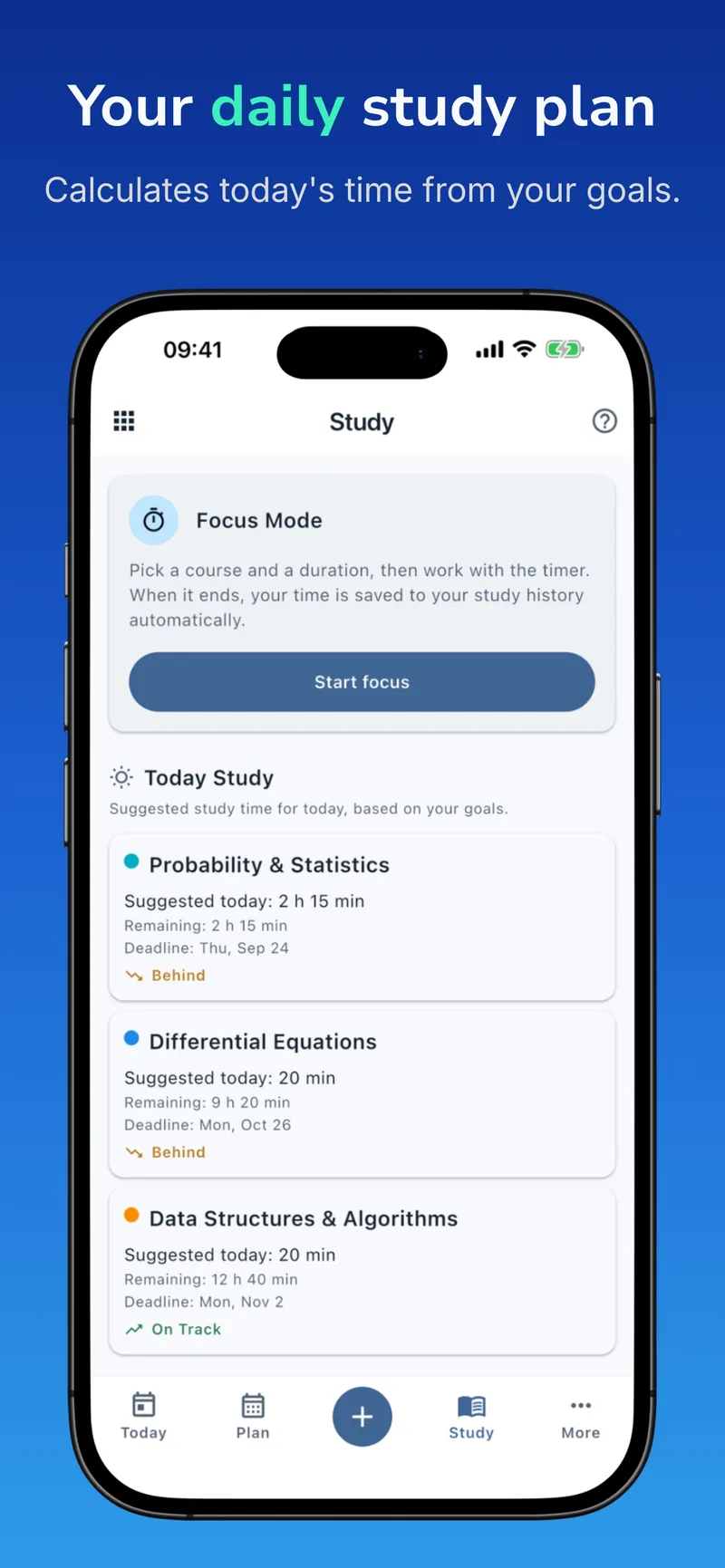
Focus Mode in BudStudy lets you pick a course and a duration and study with a timer; when the session ends, the time is added to your study history automatically. When you link a study goal to an exam, the app suggests how long to study today based on your goal and shows which courses you're behind in. You get focused blocks and spaced study in one place.
Last updated: 25 September 2026
Related guides: